The Best Socks for Walking: Fibers, Cushion and Fit Explained
November 4, 2026
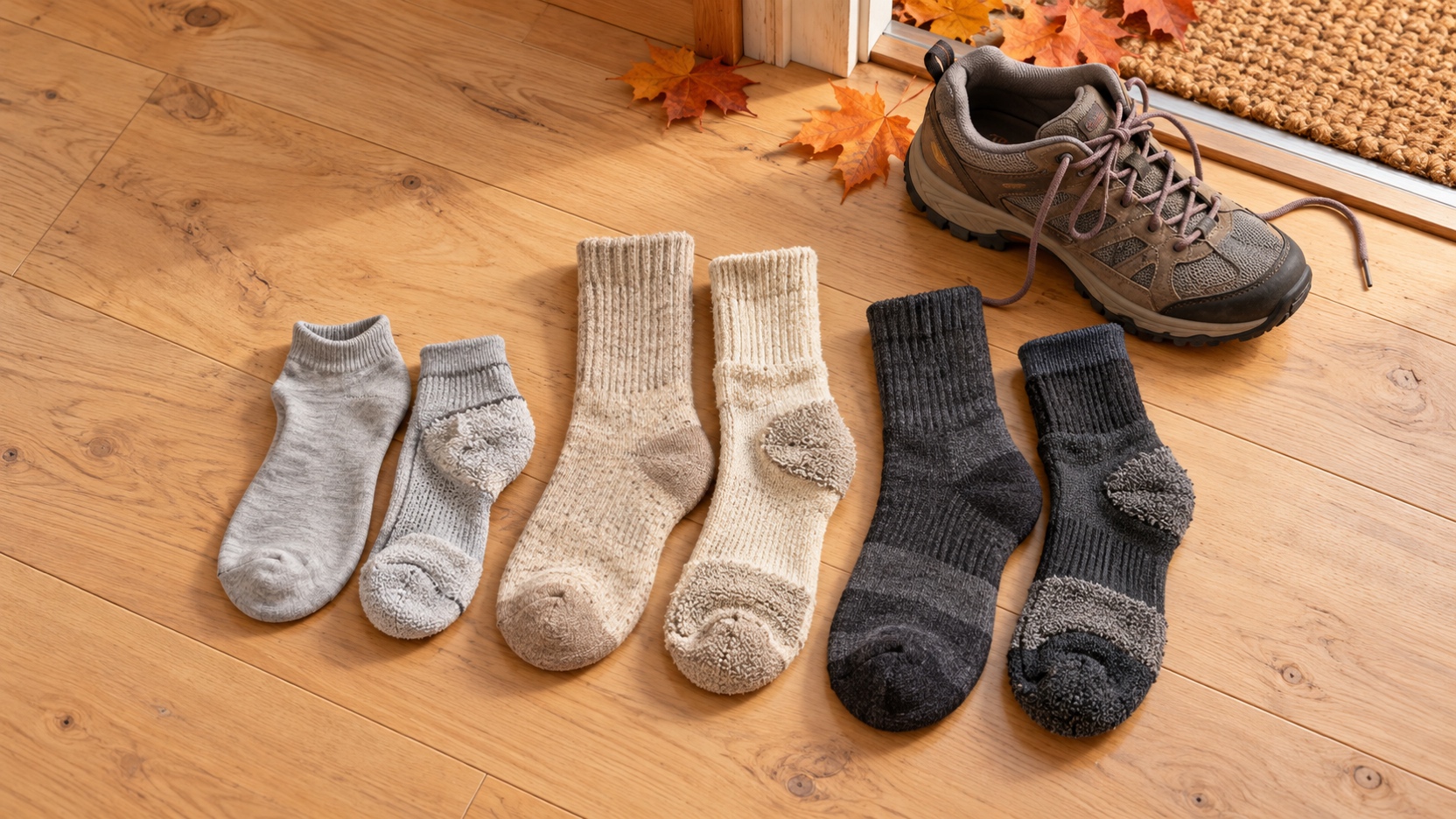
Two miles into a walk, you feel it: a warm spot on the back of your heel. The shoes are the same ones you wore all summer. What changed is the weather, the sweat and, very often, the sock.
Socks get less attention than shoes, but they sit between your skin and everything else. The right pair keeps your feet drier, cuts friction and helps the shoe fit the way it should. Here is what to look for, fiber by fiber.
Why the sock matters
Blisters start with friction, and damp skin rubs more easily than dry skin. That is why the American Academy of Dermatology's first suggestion for preventing foot blisters is to wear nylon or moisture-wicking socks, along with shoes that are neither too tight nor too loose.
A sock's job is to move sweat away from the skin so the shoe can let it out. Texas A&M's health guidance calls the sock your first line of defense against sweat, which can lead to rubbing, blisters and fungal infections when it stays put.
Cotton: fine on the couch, not on the walk
Cotton feels soft and costs little, which is why most drawers are full of it. On a walk, it works against you.
Podiatrist Douglas Richie, writing for the American Academy of Podiatric Sports Medicine, summarized lab tests showing that cotton holds about three times as much moisture as acrylic and stays wet about ten times longer. Wet cotton fibers swell by roughly 45 percent, compared with under 5 percent for acrylic, which slows drying even further. Runners in those tests also found that wet cotton socks stretched and bunched inside the shoe.
REI's sock guide puts it simply: avoid cotton for active use because it absorbs sweat, dries slowly and raises the risk of blisters. A cotton blend with plenty of synthetic fiber is a step better. A 100 percent cotton tube sock is the one to retire.
Merino wool: the all-season option
Merino is not the scratchy wool of old ski sweaters. The Woolmark Company explains that merino fibers are finer than human hair, and that itch comes from coarse fibers, not from wool itself.
For walkers, merino's strengths are comfort across temperatures and odor control. REI describes it as soft and temperature-regulating, with natural cushioning, while noting that it dries more slowly than synthetics and costs more. Texas A&M adds that merino helps control odor and can keep feet cool in summer and warm in winter.
Most merino walking socks are blends. Richie notes that 100 percent wool can feel abrasive, which is one reason wool is usually mixed with synthetics, and a little nylon or elastane helps the sock keep its shape.
Synthetics: the quick-drying workhorses
Polyester (including CoolMax), acrylic and polypropylene are the fibers built for wicking. REI notes they are durable and dry fast, while nylon and Lycra are added to most socks so they keep their shape. The trade-off, according to Texas A&M, is that synthetics control odor less well than wool, though they are usually cheaper.
The research on synthetics is older but consistent. In the military studies Richie describes, a thin synthetic liner under a padded outer sock cut blisters among Marine recruits from 69 percent to 40 percent over basic training, and several studies favored two-layer sock systems over a single thick sock. Earlier work by Herring and Richie found acrylic socks produced fewer, smaller blisters than cotton, but only when they had dense padding.
For most daily walks, you don't need a liner. If you are prone to blisters or are planning long days on your feet, a thin liner or a double-layer sock is worth trying.
Cushion: where it goes and how much
Padding belongs where your foot takes the most pressure. REI suggests looking for cushioning at the heel and the ball of the foot, and warns that too much padding can make your shoes feel tight.
A few details separate a good walking sock from an ordinary one:
Flat toe seam. A thick ridge across the toes is a common source of rubbing. Texas A&M recommends flat-knit toe seams and a Y-stitch heel, which follows the shape of the heel.
Thickness matched to your foot. REI suggests midweight socks for low-volume feet (narrow or low instep) and lightweight socks for high-volume feet (wide or high instep).
Arch band. A snug knit around the arch keeps the sock from sliding, though support itself should come from the shoe.
Fit: the step most people skip
A sock that is too long bunches under your toes. One that is too short slides down at the heel. Either can cause blisters, so check the size chart rather than buying "one size fits most."
Fit also works in the other direction. Richie advises fitting shoes while wearing the socks you will actually walk in. In a fit study he reports, adding a thick, padded sock to properly fitted shoes called for a longer shoe 77 percent of the time. Our sizing guide covers the rest of the process.
Height for the way you walk
On pavement and smooth paths, a no-show or ankle sock is fine as long as it covers the back of your heel. Texas A&M suggests crew or calf length on trails, where it protects against brush and debris. In cold weather, a taller merino sock also keeps your ankles warm.
If you have diabetes
People with diabetes need to take extra care, because a small rub can become a serious sore without being felt. MedlinePlus advises clean, dry socks every day, padded socks that pull moisture away from the foot, non-binding styles and avoiding seams that create pressure points. Holes in socks can put damaging pressure on the toes. Ask your healthcare provider or podiatrist which socks and shoes suit your feet.
The takeaway: a simple sock drawer
You don't need a dozen kinds. For most walkers, three types cover the year:
Everyday walks: a light-cushion synthetic or merino blend with a flat toe seam.
Cold or wet days: a midweight merino-blend crew sock.
Long days or blister-prone feet: a double-layer sock or a thin liner under your usual pair.
Replace socks when the heel goes thin or shiny, the elastic gives out or holes appear. Then pair them with shoes that fit; our look at the Brooks Ghost 18 shows how to judge a daily walker.
Educational information only. This article is general information about socks and walking comfort and is not medical advice. If you have diabetes, poor circulation, numbness or a foot wound, talk with your healthcare professional before changing your footwear.
Sources
- American Academy of Dermatology: How to Prevent and Treat Blisters
- Texas A&M Howdy Health: How to Choose the Best Socks for Your Feet
- American Academy of Podiatric Sports Medicine: Socks and Your Feet
- REI Expert Advice: How to Choose Socks
- The Woolmark Company: Soft Merino Wool
- MedlinePlus (U.S. National Library of Medicine): Foot Care
- sizing guide
- Brooks Ghost 18