Walking After Dark: How to Be Seen on Autumn Evenings
October 20, 2026
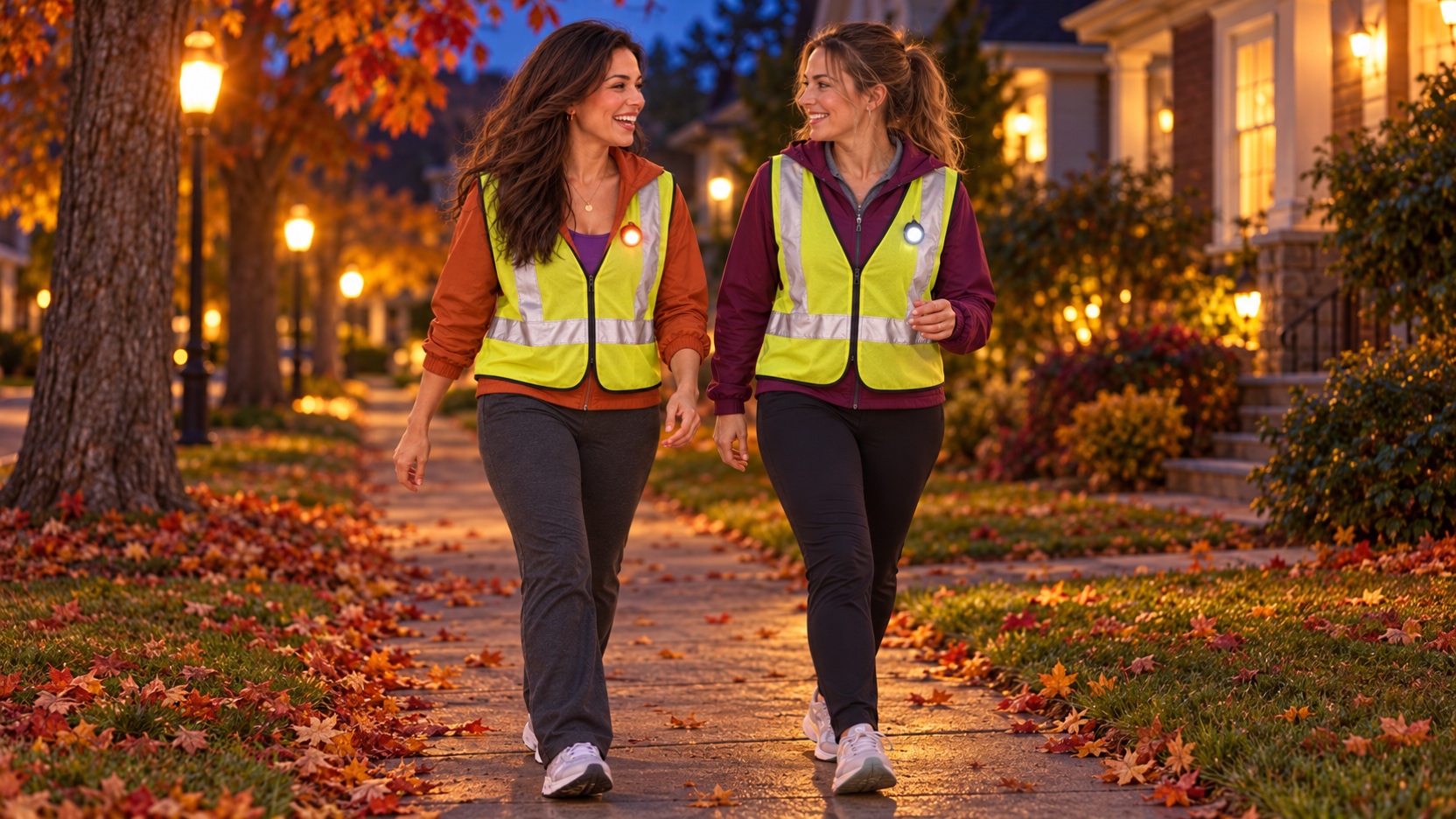
At 5:30 on a November evening, the walk that was easy in July happens in near darkness. You can see the headlights coming toward you, so it feels as if the driver can see you too. Often they can't, at least not in time.
On Sunday, November 1, clocks in most of the U.S. fall back an hour at 2 a.m., and the after-work walk moves into the dark overnight. You don't need to give it up. You need a few habits and some inexpensive gear that make you visible from a distance.
Why the dark changes the risk
The numbers are sobering. NHTSA reports that 7,080 pedestrians were killed in U.S. traffic crashes in 2024, one roughly every 74 minutes, and more than 71,000 were injured.
Darkness is the common thread. The Governors Highway Safety Association notes that more than three-quarters of pedestrian deaths happen after dark, and that fatal nighttime pedestrian crashes rose 84% between 2010 and 2023, compared with 28% for daytime crashes. The same report found that 65% of pedestrian deaths happened where there was no sidewalk.
Part of the problem is a simple misjudgment. Researchers have found that pedestrians overestimate how visible they are at night: we see a car's bright headlights and assume the driver sees our dark coat just as clearly.
Reflective beats bright after sunset
Bright and reflective are not the same thing. Fluorescent yellow or orange fabric stands out in daylight and at dusk. Once it is fully dark, it needs light to bounce back, and that is what retroreflective material does: it returns a car's headlights straight to the driver.
NHTSA's advice is short: wear bright clothing during the day, and reflective materials or a flashlight at night. Most walkers get the first half and skip the second.
A light-colored jacket helps a little. A reflective band or strip helps a lot more.
Put reflectors where you move
Where you wear reflective material matters as much as how much you wear. Drivers recognize a person faster when they can see the motion of walking, which researchers call "biomotion."
In a Clemson University study reported by the American Psychological Association, walkers with reflective material on only their ankles and wrists were noticed from about 50 meters away. A single reflective patch on the torso was noticed from about 15 meters. Adding ankle bands to a standard safety vest matched the visibility of a full 11-piece reflective suit.
A 2020 study led by Joanne Wood at Queensland University of Technology reached a similar conclusion. Reflectors on wrists, ankles, knees and elbows help drivers recognize a moving person, while a vest covers only the torso. The same study found that walkers and riders tended to choose style and comfort over reflective gear. That trade-off is easy to fix.
What that looks like on an ordinary evening:
Ankle bands. Inexpensive slap-on or Velcro reflective bands are the single most useful item. Your feet are the part of you that moves most.
Wrist bands or reflective gloves. Arm swing adds a second moving signal.
Shoes with reflective details. Many walking shoes have small reflective heel tabs. They help, but they are small; don't count on them alone.
A vest if you walk on roads. Wear it with ankle bands, not instead of them.
Carry a light, too
A light does a different job from a reflector. It shows drivers where you are before their headlights reach you, and it shows you the cracked pavement, curbs and wet leaves ahead.
The CDC's walking-safety guidance puts it plainly: use lights when it's dark. A small clip-on LED on your jacket, set to flash, makes you visible from the front and back. A headlamp or handheld flashlight lights the ground. Many walkers on unlit roads use both.
Check the batteries before the clocks change, not on the first dark evening.
Choose your route for the dark
Your summer loop may not be your best winter loop. A few changes make a big difference:
Use sidewalks wherever they exist. Where there is none, NHTSA advises walking facing traffic, as far from it as you can. You see what is coming and can step aside.
Favor quiet, slower streets. The CDC suggests choosing low-speed, low-traffic roads when you can.
Cross at intersections and crosswalks, and pick well-lit spots. Wait for a clear stop before stepping out, and try to make eye contact with the driver.
Keep one ear free. If you listen to music or a podcast, keep the volume low enough to hear an engine or a bike bell.
Walk with someone. The CDC notes that walking in groups can improve safety, and company makes a cold, dark evening more appealing.
If your neighborhood has no sidewalks and fast traffic, the safest evening walk may be somewhere else: a lit park path, a school track or an indoor mall loop on the worst nights.
Mind your footing
Darkness hides the ground as well as you. Autumn adds wet leaves, early frost and puddles that look like shadows. Shoes with a grippy outsole and a secure fit around the heel matter more now than in summer. If your shoes are worn smooth, this is the season to replace them.
If you are choosing new walking shoes, our sizing guide covers fit, and our look at the Brooks Ghost 18 shows how to judge a daily walker.
Before the clocks change
This week, set yourself up for darker evenings:
Buy two reflective ankle bands and a clip-on light.
Charge or replace the batteries.
Walk your evening route once in daylight and note where sidewalks end and lighting is poor.
Swap that stretch for a better-lit one.
Then keep walking. The reasons to walk every day don't change when the evenings get dark.
Educational information only. This article is general safety guidance and is not medical, legal or professional advice. Follow local traffic laws and talk with your healthcare professional if you have questions about exercising safely.
Sources
- ABC7 — 2026 daylight saving time ends
- NHTSA — Pedestrian safety
- GHSA — Pedestrian traffic fatalities: 2024 data
- American Psychological Association — Nighttime pedestrian visibility
- NHTSA — Pedestrian safety guidance (PDF)
- Queensland University of Technology — Reflective gear and biomotion
- CDC — Make walking and rolling safer
- Walking Shoe Journal — Shoe sizing guide
- Walking Shoe Journal — Brooks Ghost 18
- Walking Shoe Journal — Reasons to walk every day